
TL;DR – A wildly ambitious film about a catastrophe in motion that struggles with its scope as it explores deeper emotional constructions.
Post-Credit Scene – There is a mid-credit scene.
Disclosure – I was invited to a press screening of this film.
The Great Flood Review Introduction –
There is a reason that floods get the moniker “biblical”, and it is not just what was described in Genesis. Water has an immense, indiscriminate power behind it at the best of times, but when rivers break their banks or waters surge from the ocean, nothing can stand in its way. It forges canyons, it cleaves buildings, and it kills with little effort. It is that power that guides the story today.
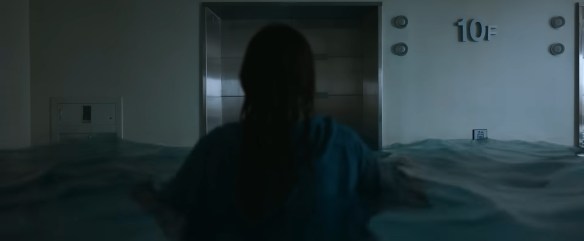
So, to set the scene, it is a day that started as typical as anything else as Gu An-na (Kim Da-mi) wakes up to find her son Ja-in (Kwon Eun-seong) already in her bed wanting one more day diving in the pool. But the normalcy was interrupted by rumbling sounds in the distance that the rain could not account for. Rice gets spilt, heads get hit, and a parent is overbearing. It’s honestly not a great start to the day. But when water starts seeping into her apartment from outside, when she lives on the third floor, Gu An-na realises something is very wrong, even if her son thinks this is the best day in the world.

Scenario
Now, before we start, there is something I do need to handwave away, which is whether this scenario of water rise after an asteroid hits Antarctica is possible, and the answer is no. Even if all the ice on the planet suddenly melted into the oceans, we would only see a 60m (195 ft) rise. Which is bad, don’t get me wrong, we are probably screwed, for example looking at some maps I personally would be dead in such a scenario. But it is not global coverage in the way shown here or in Waterworld or Paradise. However, just because something is not scientifically probable does not mean it can’t be a vehicle for emotional storytelling, which we have seen in films like Greenland.
Production
From a production perspective, this is a solid outing. Water is such a vital part of this film, and here they bring out all the stops. The large tsunami waves feel as menacing as they should, a wall of water not stopping for anything. More than that, a lot of the movie is filmed in tanks, which is a difficult medium to get right. All of the production team behind this film should be congratulated for the work they put into making those underwater scenes work as well as they do. This gets extended as the film continues with a specific visual aesthetic that is quite captivating in the way it is displayed.

Narrative
On that front, how does The Great Flood work on that emotional level? Here, it is a bit of a mixed bag during parts of its runtime. Some moments hit on a profound emotional level. However, that is not always the case, and I think this is not helped by the awkward foundation that the film sets for itself. Gu An-na is not a compelling character at the start, and her depiction as someone who can only use tears to persuade people is almost reductive in the modern era. This is not helped by Ja-in being a character I hate in disaster films, someone who only exists to be an impediment for other characters. This occurs in some profoundly convoluted situations that add to the frustrations. For example, when he runs into a strangers apartment for no reason.
Interestingly, this is a film with two totally different halves, but to discuss that, we need to explore the dramatic shift halfway through, so there will be [SPOILERS] moving forward. In the first half, we get a very straightforward disaster film in the vein of, say, Just a Breath Away, where you have to keep moving up from the danger rising from the surface. It then morphs into an odd combination of The Matrix, The OA, and a time loop romp. The first half is the stronger narratively because there is a clear direction that the movie is driving towards with speed. The second half is more esoteric, disjoined, and narratively muddled, as it explores the nature of emotion. However, it is also, creatively, the more interesting work, especially when it starts to lose some of its narrative constraints. I am not sure that the film with such distinct halves works as a united whole; however, it was fascinating to watch from an experimental perspective.

Recommendation
In the end, do we recommend The Great Flood? Maybe. While I am not sure it achieved what it set out to do. What is clear as the film progresses is that it is a wildly more ambitious film than it first lets on. That ambition and experimentation are to be commended, even if they don’t quite pull it off.
Have you watched The Great Flood? Let us know what you thought in the comments below. If you liked The Great Flood, we would recommend Leave the World Behind to you because it also explores family bonds in the face of an apocalypse, where you have to shift everything you know about the world to survive.
By Brian MacNamara: You can follow Brian on Bluesky at @Tldrmovrev, when he’s not chatting about Movies and TV, he’ll be talking about International Relations, or the Solar System.
Feel free to share this review on social media and check out all our past reviews and articles Here, and have a happy day.
Credits – All images were created by the cast, crew, and production companies of The Great Flood
Directed by – Kim Byung-woo
Written by – Kim Byung-woo & Han Ji-su
Cinematography by – Kim Tae-soo
Production/Distribution Companies – Hwansang Studios
Starring – Kim Da-mi, Park Hae-soo, Kwon Eun-seong, Kang Bin, Jeon Yu-na,
Rating – Australia: M;
 TL;DR Movie Reviews and Analysis