TL;DR – Elegant, stunning, and powerful, it is a film that will stay with me for a long time even though I don’t think I will ever watch it again.
Post-Credit Scene – There is no post-credit scene.
Disclosure – I was invited to a press screening of this film.
Warning – Contains scenes that may cause distress.
The Brutalist Review –
Today, we look at a film that absolutely captivated me from start to finish, and given that it is three and a half hours long, that is a lot of runtime to have to keep you engaged. However, I think you might see how each and every step captivates, even when the film can be deeply uncomfortable.
So, to set the scene, László Tóth (Adrien Brody) is a Hungarian Jew who was separated from everyone he loves during World War Two. Escaping Europe by himself, he manages to make it to America and go live with and work for his cousin Attila (Alessandro Nivola) in Philadelphia. Things are tense in the closed environment. However, a chance encounter with Harry Lee Van Buren (Joe Alwyn) puts him into the orbit of the powerful, industrious Harrison Lee Van Buren (Guy Pearce), someone who might just let László create his brutalist masterpiece.
What The Brutalist does best is know how to capture and keep your attention, even when it is working through some profoundly uncomfortable or dense subject matter. You can see this right at the start as we witness a narration from László’s wife, Erzsébet (Felicity Jones), who clearly loves him but who has also been left behind. All while, we have this long shot of László being roused from sleep and escaping onto one of the last ships. It is frenetic, and you feel the tension ebbing into every pore of the scene. It also sets the tone for everything that will follow in the rest of the film.
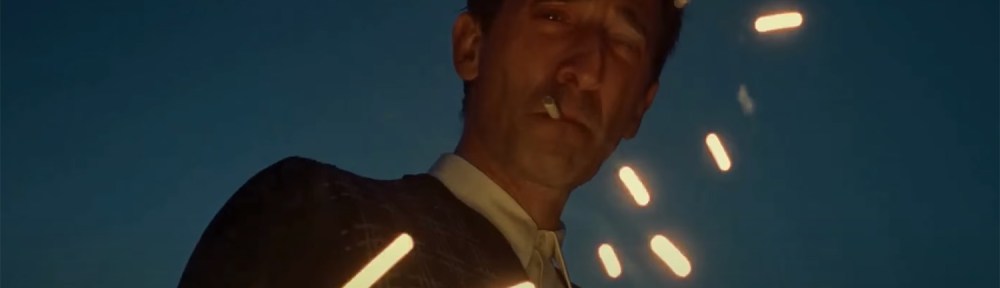
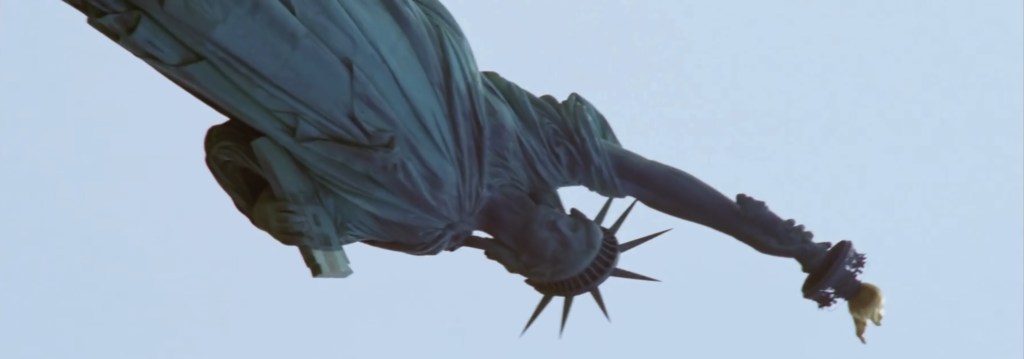
There is never a dull shot in the film because the camera is always positioned in the most interesting place. Even if that is just like a metal frame being welded together and sparks flying everywhere. What I really loved was those scenes when the camera becomes an entity in the moment, like you are not just a fly on the wall watching in but part of the scene yourself. The most famous example of this is probably right at the start when they arrive in America and see The Statue of Liberty for the first time, and it is not framed as you would expect. But being a participant in the scene makes you also become complicit in the structures around you, which is not always a good thing, as the film knows. For every profound triumphant speech, there are also narrative slaps to the face, and you feel both equally.

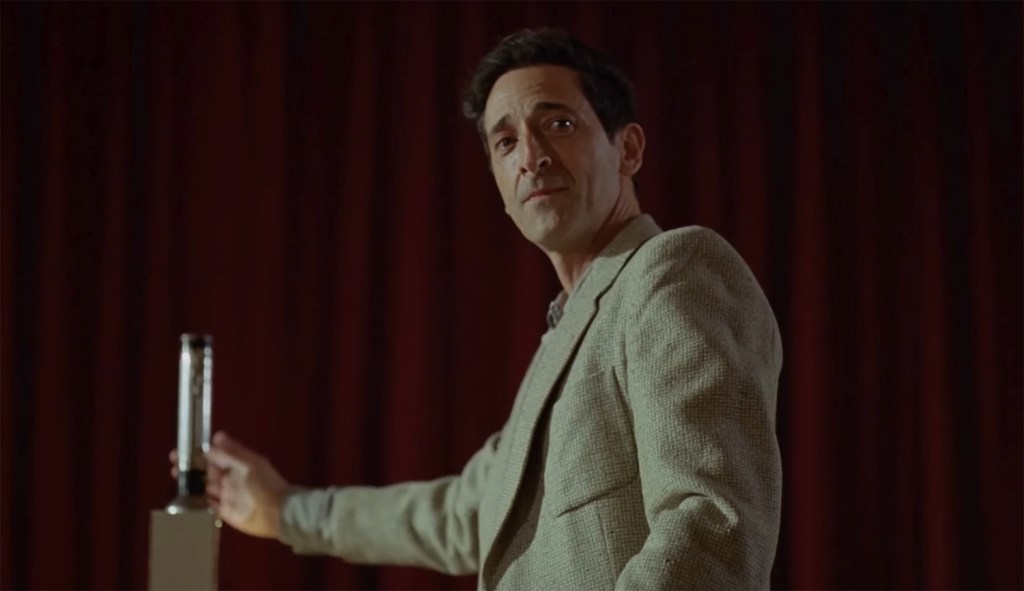
This is quite a contained film, which means that the casting might be the most critical part, and here, that absolutely nailed every part. Adrien Brody is as captivating as László even when he is generally unpleasant. There is a passion and drive that he brings to the performance that you need, or the whole movie would have felt disingenuous. To counter that energy, we have Guy Pearce performing a pitch-perfect wealthy industrialist. He is charming, friendly, and captivating, but also someone with so much money that he consistently dehumanises everyone he sees. He brings a performance that is so disarming before just casually reminding you just how profoundly racist the character is.
While these two characters are the poles, the film aligns itself around in the first half. We then get a fundamental shift in the second as Felicity Jones and Raffey Cassidy arrive as Erzsébet and Zsófia. They are the perfect disruptors for the film because, with their performances they shine a light on all the shallow proclamations of the Van Buren’s. We also have a strong supporting cast, such as Joe Alwyn, who perfectly captures the spoiled, conceited, and over-self-assed son of a wealthy man. Who spouts words of wisdom as if he had worked a day in his life. I also loved Jonathan Hyde in his work as Leslie Woodrow because I think he might have been the only honest person that László worked on in the project.

Narratively, The Brutalist is quite fascinating because it explores several profound themes. There is the obsessive drive of an auteur to design and make his masterpiece even though he is being cut down in little ways by everyone around him. Then, there is an exploration of America in the 1950s, a world that is exploding with ideas and people but is also stuck in a different era. The impact of money and power on people’s lives. There is an unpacking of what the architectural design of brutalism means and its origins. However, there are also the things that are left unsaid, but are also at the forefront of everything, such as what happened to László, Erzsébet, and Zsófia during the war.
While this is a fascinating film to watch, it is also a profoundly difficult one to explore at times. As László tries to cope with the world around him, he turns to hard drugs, which impacts everyone around him. Then there are the multiple intimate scenes throughout the film, all of which are some levels of uncomfortable to watch. It is these things and more that make The Brutalist a hard movie to watch at times and had you pondering the themes during the intermission. However, while these uncomfortable elements exist, they add to the story in interesting ways. While I am slightly embarrassed to mention this, I was so captivated by the story and the characters that I kind of thought I was watching an accurate biopic of a post-WW2 Jewish architect who was one of the founders of the brutalism movement and even went to look up more information of the people after the movie, only to find it was a fictional story. Embarrassing for me, yes, absolutely, but it also shows just how captivating the writing was in creating these characters.
In the end, do we recommend The Brutalist? Yes, we would. However, I would add a note that while it was profoundly moving, it was also fundamentally uncomfortable in places, and I don’t think I would go back for a second time. Have you watched The Brutalist? Let us know what you thought in the comments below. If you liked The Brutalist, we would recommend to you Touch.
By Brian MacNamara: You can follow Brian on Twitter Here, when he’s not chatting about Movies and TV, he’ll be talking about International Relations, or the Solar System.
Feel free to share this review on any of the social medias and you can follow us Here. Check out all our past reviews and articles Here, and have a happy day.
Credits – All images were created by the cast, crew, and production companies of The Brutalist
Directed by – Brady Corbet
Written by – Brady Corbet & Mona Fastvold
Music by – Daniel Blumberg
Cinematography by – Lol Crawley
Edited by – Dávid Jancsó
Production/Distribution Companies – Brookstreet Pictures, Kaplan Morrison, A24, Focus Pictures & Universal Pictures
Starring – Adrien Brody, Felicity Jones, Raffey Cassidy, Guy Pearce, Joe Alwyn, Stacy Martin, Ariane Labed, Alessandro Nivola, Emma Laird, Isaach de Bankolé, Michael Epp, Jonathan Hyde, Peter Polycarpou, Maria Sand & Salvatore Sansone
Rating – Australia: MA15+; Canada: 18A; Germany: na; New Zealand: na; United Kingdom: 18; United States: R
 TL;DR Movie Reviews and Analysis
Pingback: The Musical Scores of 2025 That Wowed Us | TL;DR Movie Reviews and Analysis
Pingback: Cinematography That Made You Go Wow in 2025! | TL;DR Movie Reviews and Analysis
Pingback: My Top 20 Films of 2025 | TL;DR Movie Reviews and Analysis