
TL;DR – A quiet, thoughtful meditation on the effects of grief and trauma from a number of perspectives.
Disclosure – I paid for the Paramount+ service that airs this series.

Star Trek: Starfleet Academy – The Life of the Stars –
As we get into the back half of the season, it is clear that Come, Let’s Away is the fulcrum that the whole season pivots on. That is interesting because last week’s attempt to explore the repercussions of the event, Ko’Zeine, fell flat on its face for me. But maybe the second time is the charm.
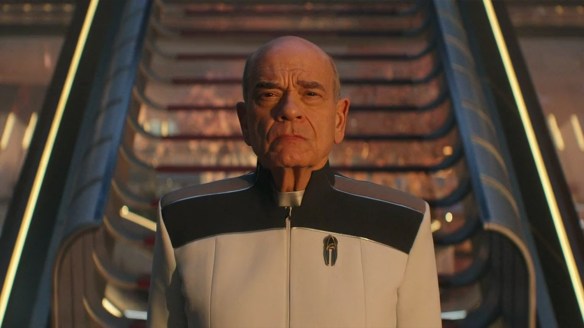
So, to set the scene, as Tarima Sadal (Zoë Steiner) arrives back on Earth, she is no longer attending the War College because of the fear of permanent damage if she uses her powers again. This puts Tarima in an odd place, being so close to where she wants to be but missing out. It adds to the pain that has been bubbling up for a long time and is affecting the candidates’ ability to work as a team. Seeing the problem and knowing it could lead to irreparable damage, Chancellor Nahla (Holly Hunter) decides to bring in some reinforcements in the form of Lt. Sylvia Tilly (Mary Wiseman). But for one of the cadets, it might be too little, too late. Now, from here, we will be looking at the episode as a whole, so there will be [SPOILERS] ahead.
Trauma and Drama
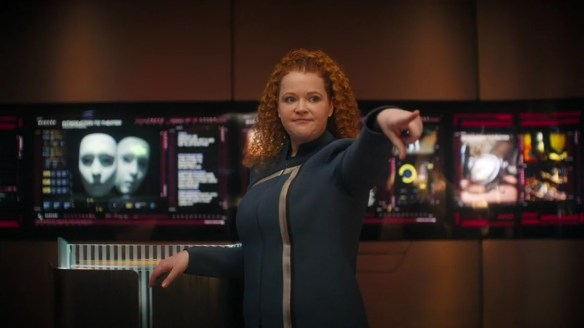
One of the main themes this episode explores is the impact of trauma on people, its legacy, how it digs inside you and changes you, even if you don’t realise it is happening. It is not a demon that can be just exorcised by saying a few good words; it is something you must work hard at, exploring yourself, and stepping back from the brink. Indeed, it can be so difficult even to start the process of healing that they have to create this class in the theatre to help the students work through their grief without them realising that is what is happening. It is a fascinating teaching technique and the perfect situation to let Mary Wiseman shine, or as one of my friends put it: “they deployed her like a finely-tuned emotional scalpel”.
The centrepiece of this week’s episode comes from Thornton Wilder’s seminal play Our Town, which, being not American, I was unfamiliar with before today, but the episode does a good job of framing the play even for those who might not be familiar. The play becomes a framework that the students could then act out about, reminisce with, grieve through, or get angry at. It gave their emotions a place to be focused on, even if it was a rocky road to get to the ending. In this space, I liked the refrain of “don’t be the captain that tears down, be the captain that lifts up”, and goodness, don’t we need more of that today. It was not a smooth ride, and wow, did Tarima say some brutal things to Caleb (Sandro Rosta). But the play let the cadets feel, and through feeling comes understanding, and through understanding comes the first steps towards reconciliation.
Grief
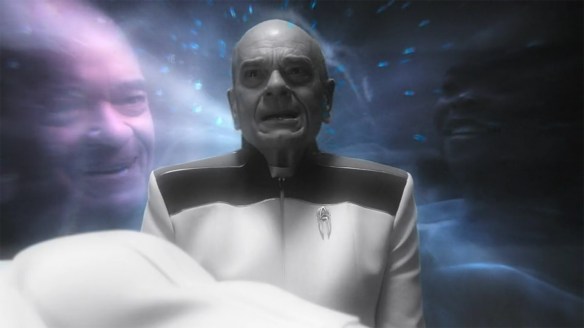
While grief and trauma go hand in hand quite often, this week, while the students are facing their trauma, The Doctor (Robert Picardo) is facing the years of grief he has been holding onto since his activation on the USS Voyager. We know he has watched the crews of at least the USS Voyager and the USS Protostar grow old and die, and he might be the only one left these days. Now compound that across the 800-odd years between those crews and now. Each death adds to the grief like a brick building a wall, a wall to barricade yourself from the emotions that you are not ready to face, because it is just simply too much to think about and be able to continue to function.
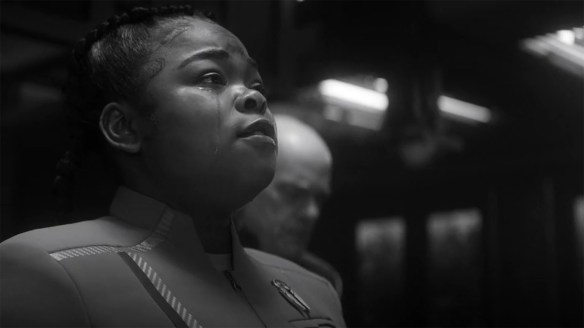
To say that Robert Picardo’s performance in this week’s episode moved me would be an understatement to be sure. You felt his pain, his hesitation, his final acceptance of what was holding him back. It is honestly difficult to write about it now, while still being emotional about it. But this section of the story would not have worked if SAM (Kerrice Brooks) were not an integral presence in the show. Her relentless positivity is frankly needed in the show, and I think in the world in general at the moment. Their work together in this episode wounded me and uplifted me.
Continuity
However, I want to take a moment to end this episode exploring, for a moment, how Star Trek Starfleet Academy deals with continuity, and I don’t mean in the canon/lore aspect of continuity, but in how it situates itself with the other Star Trek series. We saw the start of this in Series Acclimation Mil, where the show decided to answer one of the lost questions at the end of Deep Space Nine, and from my perspective, did it in the most respectful way possible, given the real-world context they were working with.
Part of this week’s episode is in dialogue with Star Trek Voyager, a discussion that tries to say that maybe it didn’t always follow through the best with the characters and situations it created. When Voyager came on the air, there was a reaction to a lot of the connected storylines that were featured on Deep Space Nine, and a drive to go back to the “story of the week” model more or less that had served Star Trek well up to that point, with some minor deviations, i.e. Seska, etc. This means that while Voyager has some of the best single-entry episodes in Star Trek, you can ask any Star Trek fan, and they will be able to tell you a couple of banger episodes. It also suffered from the end-of-episode reset button all the time, sometimes quite literally.
Very few elements of the series escaped the single episode, unless it was fun and quirky, and that means we are absolutely getting a whole episode on Tom Paris’ off 1930’s Sci-Fi holodeck series. But when it came to the deep emotional stuff, nope. Which means that we thankfully don’t bring up that time two crew became lizards, okay, Lower Decks did, but no one else. But then we don’t explore the many times that The Doctor had really profound emotional experiences. One of those episodes was called Real Life, and it is the episode that we use as a reference point this week. Giving The Doctor emotional growth from this episode, even if it took almost 30 years to happen, makes both series better for it being there, and gives Robert Picardo a foundation to break my heart with.
Recommendation
In the end, do we recommend Star Trek: Starfleet Academy – The Life of the Stars? Absolutely. This is one of the standout episodes of the season. Could I get nitpicky about time-dilation-shenanigans and other small points, of course. But none of them even dent what a wonderful episode this was and the emotional impact it had on me. Have you watched Star Trek: Starfleet Academy – The Life of the Stars? Let us know what you thought of the new series in the comments below.
By Brian MacNamara: You can follow Brian on Bluesky at @Tldrmovrev, when he’s not chatting about Movies and TV, he’ll be talking about International Relations, or the Solar System.
Feel free to share this review on social media and check out all our past reviews and articles Here, and have a happy day.
Credits – All images were created by the cast, crew, and production companies of Star Trek: Starfleet Academy
Directed by – Andi Armaganian
Written by – Gaia Violo & Jane Maggs
Created by – Gaia Violo
Based On – Star Trek created by Gene Roddenberry
Production/Distribution Companies – Secret Hideout, Warm Blood Sunday, Roddenberry Entertainment, CBS Studios & Paramount+
Starring – Holly Hunter, Sandro Rosta, Karim Diané, Kerrice Brooks, George Hawkins, Bella Shepard, Zoë Steiner, Brit Marling, Stephen Colbert, Tig Notaro, & Robert Picardo
With – Mary Wiseman, Chiwetel Ejiofor, & Romeo Carere,
And – Sophia Wynter
 TL;DR Movie Reviews and Analysis
Pingback: Star Trek: Starfleet Academy – Rubincon [S1E9] & Season 1 – TV Review | TL;DR Movie Reviews and Analysis