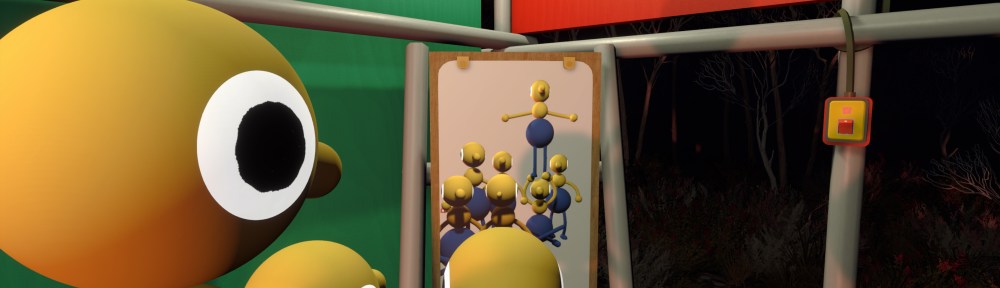
TL;DR – Big Walk is a game that has somehow captured charm and inserted it into every single framework, from the game mechanics to the design, and most importantly, the interactions.
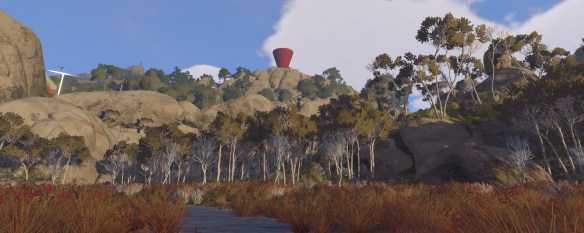
Big Walk Review Introduction
Today we are looking at the latest entry from Australian video game studio House House. They have a history of creating quirky and engaging games, so I was very interested to see how their next work would play out. That interest was only heightened when I discovered it was a cooperative adventure puzzle game, which felt like the perfect medium for shenanigans. Now, before jump into the review proper, I should be clear that at the time of writing I am about halfway through the game [The Blue Tower], but given what we will talk about below, I feel that I have seen enough of the game to cement my feeling on it.
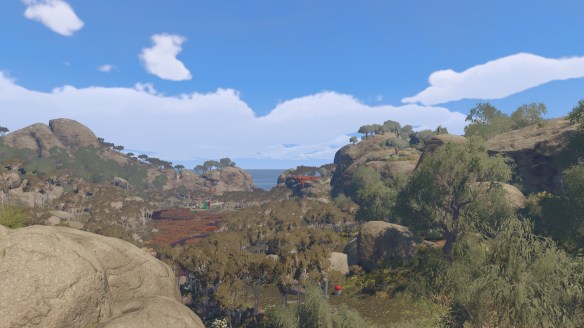
So, to set the scene, you open in on a tutorial room where you can quickly run through all the controls under the leaves of a eucalyptus tree. Once your team is ready, you can dive out into a coastal valley below. Along the river valley leading out into the sea, you can spot different structures sticking out from the bush landscape. Each of these structures has a puzzle that you and your friends (also possibly family members, acquaintances, frenemies, co-workers, or heated rivals) have to work together to release a red item that my group ended up calling a gourd, which you insert into a machine to unlock a key that gives you access to the next location. While this starts quite small and manageable, it soon expands in scope.
Game Mechanics
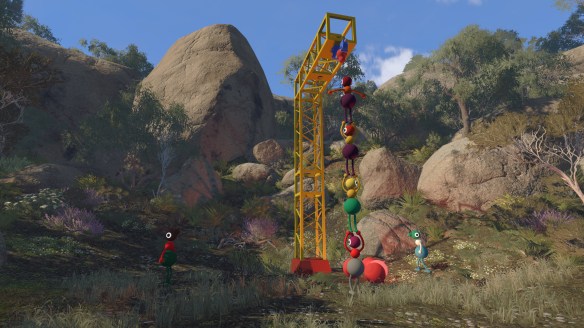
From a mechanical perspective, it has been quite interesting to see the scope of the puzzles they have been able to achieve with a small number of inputs. You can poke buttons, you can pick up and kick items, and you can work in a team to put all of those together. Some of the best parts of the game are when you come across a new puzzle, and as a group you explore just what is going on until someone sees the mechanic. A good example of this is in the first area when everyone must click a button at the same time, but you are positioned just out of hearing range, so you need someone in the middle who can talk to everyone to count down. You can also approach puzzles in different ways. For example, there is one puzzle when you need to work out which orbs are good and which will force a reset, and we mapped this out using items to flag the bad orbs. But I have heard of some groups making maps, and others using players as markers, and more, but they all work to people’s strengths.
Indeed, the game is quite clear that you should not be playing this in the same room as someone, or on separate Discord calls, etc. Because the proximity chat system is baked into everything that you do, now, could the sound falloff be a touch more forgiving? Yes. But it does lead to the wonderful moments, like when we had a puzzle where the people in the soundproof room knew which button to press but could not tell anyone else. How do you communicate? Then there was this shout from across the puzzle area: “the laser pointer”. It does give you that escape room feeling of working out all the clues; that is a touch addictive once you get going.
Game Design
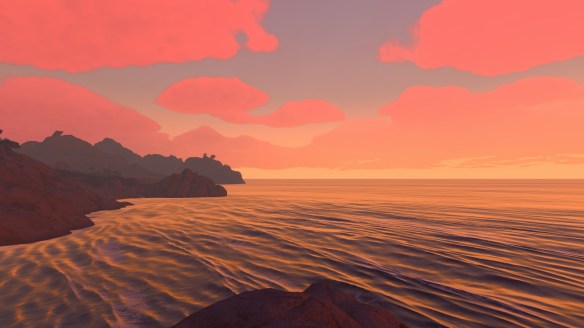
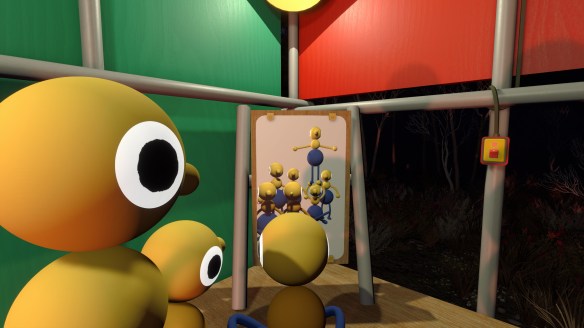
While the mechanics are all solid, and it is good to build a game around a good engine, where the game shines is in the deliberate design choices that make everything pop. The first obvious choice was to make the landscape heavily influenced by the Australian landscape. My heart skipped a beat the first time I saw the tannin-drenched creek weaving through the sand towards the beach, or the grass trees up in the high country, or even that telltale sound of a whipbird. Just sitting in the world is stunning to behold. You then take this natural setting and juxtapose it with the visual styling of the avatars, who are these goofy little guys and feel like a deliberately harsh choice to set them apart from the realistic nature. This also extends to the puzzle areas that are constructed out of bright primary colours, like painted concrete structures. The bold designs help in orientating yourself on the map but also is an architectural style that I know I have seen in the Australian landscape.
Another important place where you see that design is in the soundscape the game uses to embed you into the world. For most of your time in the game, you will be presented with a soundscape that is entirely natural sounds. For example, the game uses the cry of a kookaburra at the terminus of night and day. As someone who has spent time in the bush, these are pitch-perfectly accurate to the Australian experience. Once again, the game juxtaposes these incredibly natural soundscapes with these bursts of musical whimsy. The composers have created these musical interludes that happen at key points in the game. These jump out at you as voices rise and fall across different melodies. It is the perfect accent on your experiences in the game.
Game Cooperation
You can have a good engine under the hood, and a flashy presentation, but then the final question is: how does it drive? And in a game all about interactions, that interactivity becomes the litmus test as to how well it works. Now, I do feel that your mileage will very much vary depending on which group of friends you bring into the game. However, that game helps this by some clever design throughout. The opening tutorial room helps bring everyone together, which is then supported by the first area curating your experience, so you truly understand the tools available to you. The addition of a flare that can call everyone back to you was a great choice. That opening section is also a good litmus test as to if your group is ready for the trials ahead.
The game gives you all the tools you need to communicate and complete it as a team, but then, of course, how you interpret and implement those is going to be very different in each group. I am not sure many others would have come across the customisation option at the start of the game and decided to immediately turn us into Minions. Nor would they have decided to sing Ave Maria whenever someone drops out of the game because of the way their avatar looks. Or absolutely lose it over the reveal of a map room, though I may be a touch biased on that front. Big Walk creates the framework for you, and because that framework is so solid, you feel comfortable adding your own layer on top of it.
Recommendation
In the end, do we recommend Big Walk? Yes, yes, we do. Now, this is a multiplayer-only game and works best in a group, but there are options that include it if you are just in a pair. Which does mean there is a slight barrier to entry. But if you have the right group, Big Walk delivers some of the most enjoyable cooperative moments I have experienced in a long time. indeed, this review only scratches the surface of the joy that it is playing this game.
Have you played Big Walk? Let us know what you thought in the comments below.If you liked Big Walk, we would recommend PEAK to you because it also understands the power of cooperative gameplay that helps build a world around you.
By Brian MacNamara: You can follow Brian on Bluesky at @Tldrmovrev, when he’s not chatting about Movies and TV, he’ll be talking about International Relations, or the Solar System.
Feel free to share this review on social media and check out all our past reviews and articles Here, and have a happy day.
Credits – All images were created by the staff of Big Walk
Game Team – Stuart Gillespie-Cook, Michael McMaster, Jake Strasser, Nico Disseldorp, & Kalonica Quigley
Sound and Music Team – Em Halberstadt, Nicholas Zhang, Sam Gill, & Luke Neher
Developer – House House
Publisher – Panic

